![Designing an Overwatch map [Update 2]](https://images.squarespace-cdn.com/content/v1/5a3eb3be18b27d418cbf5aaa/1586242144535-LWS0BVSCA88JH82ZB1ED/maxresdefault.jpg)
Designing an Overwatch map [Update 2]

This week I analyzed a non-traditional control map, MEKA Base from Busan. MEKA Base is one of my favorite maps out of all controls map, and I will tell you why after I shared my map analysis. This map is pretty complicated and very unique. There are three main reasons why I think this map is different from the other control maps: 1) Connected lanes 2) Lane Lengths 3)Control Point (CP) mechanics. Let me explain in more detail for each point.
1)) Connected lanes: A lot of the newly released control maps tend to do this. They have the usual three lanes (bot/mid/top lane), but the lanes tend to spread out once they are closer to the CP, and it is harder to switch your lanes in between. For example, in Control center, once you enter the mid lane, to go to the top lane, you have to enter the mid lane battle point in which they are connected.One thing I noticed in newer control maps, they have a buffer area in the middle where they connect all three lanes, so if you want to change your lanes before the CP fights, players have a choice to do so. They are often formed as a long corridor (MEKA Base, Busan) or open space (Sanctuary, Busan). It is more flexible for players to have a choice before it is too late to back out.
2) Lane Lengths: This only happens in the MEKA base that I have noticed. Normally mid lane is the fastest route to CP, while usually there is a battle point before entering the CP. The two other lanes (top and bot lane) act as a potential backdoor/wrap-around player options. For example, Semi-mobile and Mobile characters, like Tracer and Sombra, can use the top/bot lane to perform a sneak attack behind the enemy team. In MEKA base, the lanes act a bit differently comparing to other control maps. Mid lane still is the shortest route to the CP, but it is rather a shortcut to the CP because it takes four to six (depends on the heroes) seconds to walk from the base to CP using the mid lane, comparing to the normal mid lane which takes around fifteen to twenty-five seconds to CP. I believe the map design intends for rather intense gameplay where players have the option to "rush" to the CP. Rather having a Battle point in mid lane, top lane acts like the mid lane in MEKA base and have a battle point in the high ground, while bot lane still serves as an alternative path for backdooring/wrap around. Each lane functions different purposes, and it has rather dynamic gameplay comparing to other control maps.
3)CP Mechanics: This has another interesting innovation I have never seen in other Control Maps before, and it is moving panels on the point. Every 9.5 seconds (I timed it), three walls will rise from the ground and act as barriers for the CP, and they will stay for precisely 9.5 seconds, then they will go back down. The cycles continue for the whole duration of the round. It is interesting because the CP locates in an open area, so these panels will change the gameplay every 10 - 15secs (takes four seconds to have the walls to rise fully). I enjoy the wall mechanics a lot because it changes the gameplay dramatically. Teams are forced to adopt that moment to capture/defend the point successfully. One more note I want to add, the panels also act as vignettes for some point of view. Here is one of the examples I have captured in the game.

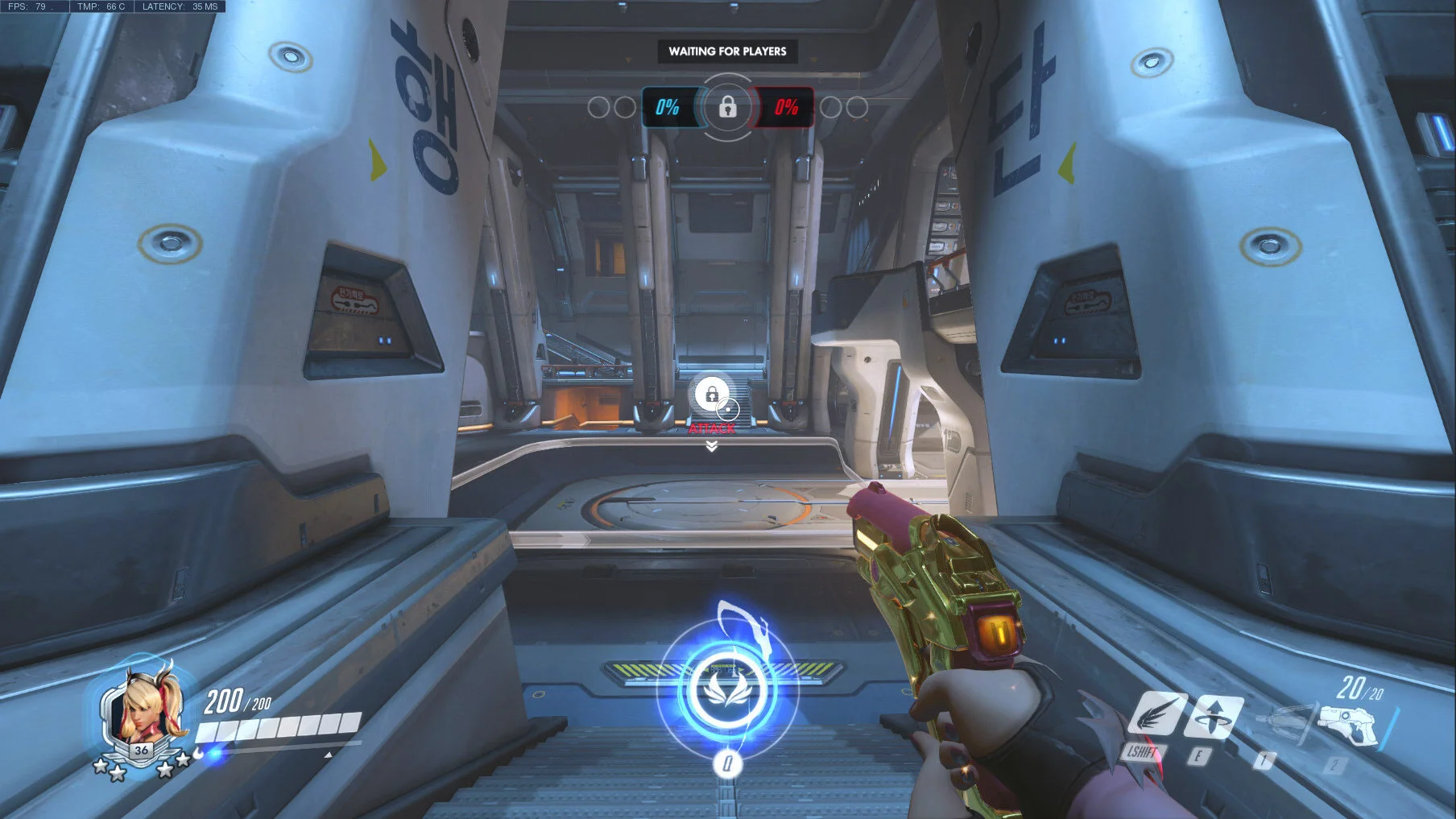
I also did some similar map analysis with MEKA Base, but I did add a few more elements: High ground and death area. I always like how overwatch control maps have a lot of different varieties of high grounds, rather if they are hard to get to, class-specific, or shared high ground. The high grounds for control maps are well-balanced. I also found out they do have a lot of direct line of sights with the enemy side.
I started out trying to find some interesting Overwatch lore to work with and I am leaning towards working on Scrapyard. In overwatchwiki, it describes Scrapyard as "The Scrapyard is an arena in Junkertown, where the Junkers carry out gladiatorial combat. These include mech battles, which are one of the most popular forms of entertainment in the town. Other forms of combat include human vs. human and human vs. omnic matches." In a way, it feels like it is describing as an arena, but in-game, it's included in a payload map.
I want to find more lore about Junkertown and possibly redesigned Scrapyard as a reimagined control map with Junkeryard feel to it! Stay tune!

![Designing an Overwatch map [Update 1]](https://images.squarespace-cdn.com/content/v1/5a3eb3be18b27d418cbf5aaa/1586242096687-8QDOEWWJGRFYWWJ3UWFN/79dfb488a93f26891a1b39ee230c9624fb7737e7_hq.jpg)
Designing an Overwatch map [Update 1]
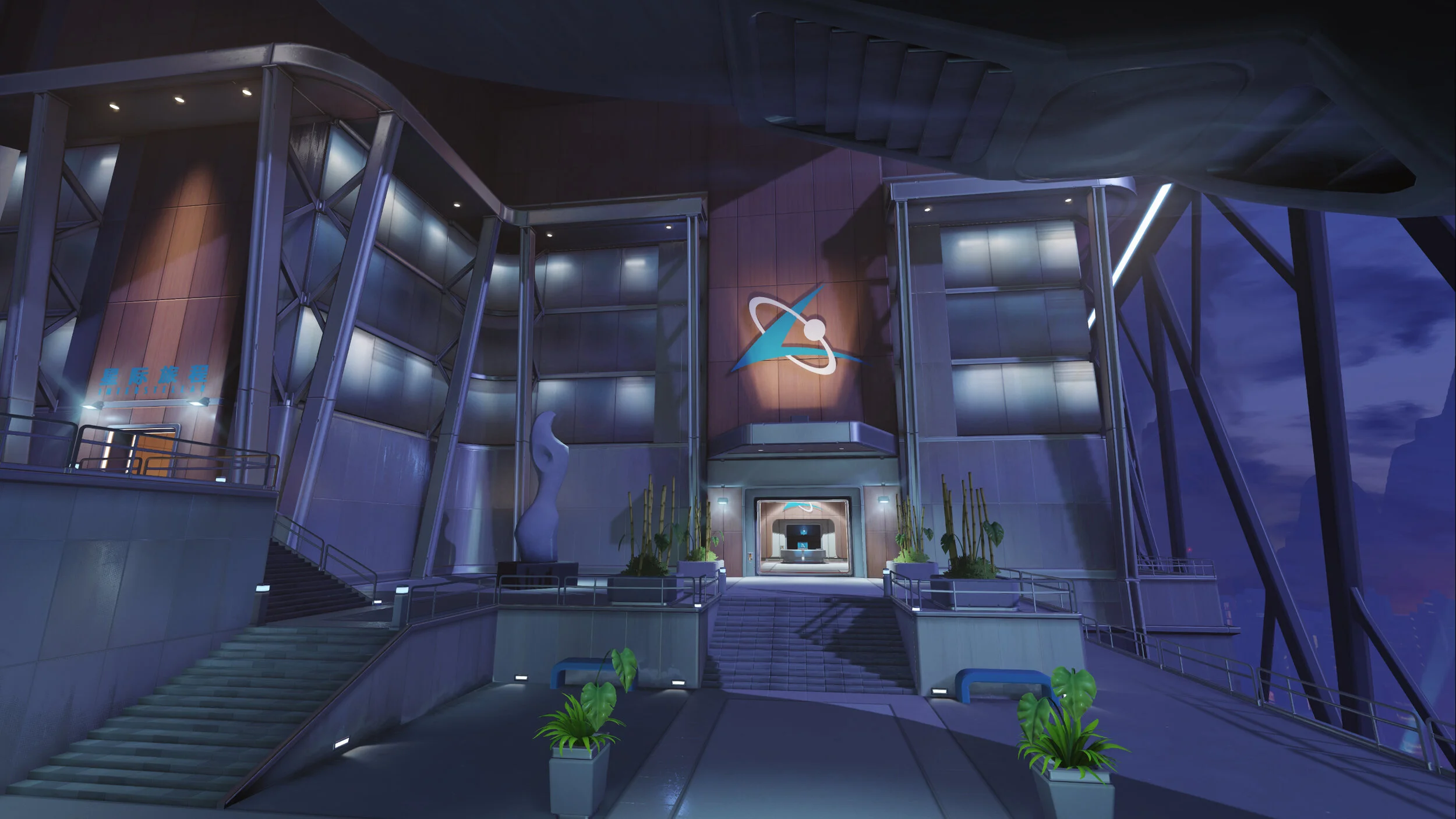
I have been working on an overwatch map since the start of 2020. I am trying to work on this project for a while now, but always not managed to finish it. I am trying to use my home quarantine time to complete as much as possible so that I can move on to some other projects haha!
I always love playing Overwatch and have been admiring how balancing the maps are, and how every map has different styles and strategies to play. I am designing a control map, which means both sides are identical that captures the center point until the team gets 100%.
Before the design phase, I always like to analyze first. I am trying to understand how control maps usually layout, as well as how some character are specifically can access to some areas, while others don't. Here are some maps I am currently analyzed, as well as some character classes I have come up with, to define some areas for some who can access versus can't. I have borrowed some top-down Overwatch maps from Reddit user, Deamon5550. Thanks for much for capturing these!

I define the classes into four types: Non Mobile(no abilities to move faster/jump higher), Semi Mobile (short range dash, short range jump) and Full Mobile (can fly, can wall climb, can teleport/dash, can jump high, fast movement, etc), alongside with their type (support/damage/tank) .Each class will be able to enter vs some area will be denied…It is generalizing how each areas will behavior and based on that, it will be useful for balancing areas which has too many high/lower areas , character specific areas…
Overwatch always have areas for different functions. Each lane has its shared area where both teams have to fight for it. Every room/area is set up differently for team fights, and teams have to use their team composition to fight for their victory. For the first analysis, I am trying to generalize the map and try to find how maps are set up normally in a control map. For the first map, I decided to analyze the Control Center map in Lijiang Tower. Control center is one of the first control maps. It has the characteristics of a standardized control map; therefore, it is a perfect case study for me. I have three different analyses for the map: Circulation (map flow), Cover (for classes), and choke points for each team.
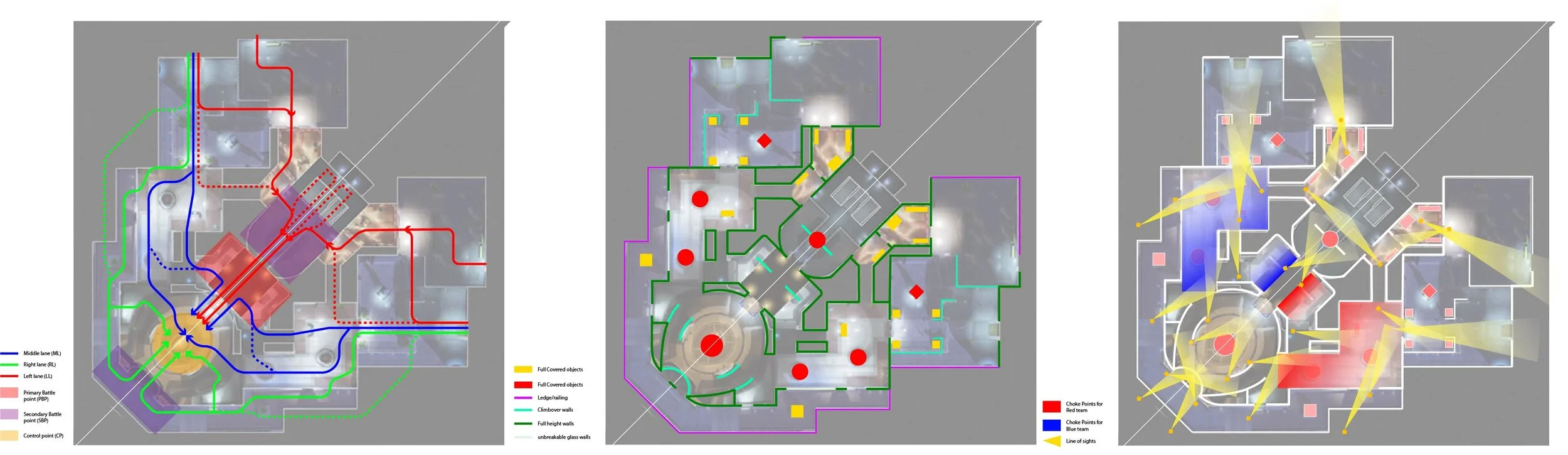
For circulation, I am trying to understand how many routes and ways for teams to tackle the point, as well as how many areas do controls have to set up any team fights.
Generally, Each lane has its own team fight areas, where the middle lane usually has a pre-control point zone where the team generally meet. The other two lanes tend for semi-mobile and mobile heroes to go through the middle lane to “sandwich” the other team. They could potentially break out a fight as well if the enemies have the same idea.
For cover analysis, I am trying to see how many percentages for full covers and half covers for Control Center. Generally, full cover objects appeared often in every room, whereas half-covered objects are more spread out around the map. Climbable walls are specifically for some heroes, such as Genji, Hanzo, Mei, etc. to jump over the walls to outplay the enemy team strategically. I do see a lot of them are around the CP to give different gameplay strategies for players to choose from. It is an exciting analysis for me.
For choke points, I decided to add line of sights as one of the elements because of most of the time. Because if you are winning, you often want to control an area in order to keep enemies away from the CP. For that reason, People often spawn camp and taken a major room/area to make sure the enemy team to go through this particular room. I do think this map, Control Center, has only one or two areas where it is worth taking over because the areas are more wide open and have a bottleneck corridor before entering the CP.
I am trying to work on this project as often as possible until I am super exhausted. For next week, I focus on working inspiration for the map I am designing, as well as another analysis for an atypical control map. See you next week!